Tuesday, 28 May 2013

Sending In Photos For Posting.

If you are sending in any photos for posting on Full Circle Fliers, don't be afraid to use a fairly high resolution. This gives better detail when the photo is viewed in Slideshow mode. If the pic is too big I can resize it to "best fit".

Send any Control Line related photos to johnmoody@westnet.com.au and include a description of each picture with any relevant information - engine size & type, weight, etc.
Adding to the list of new models is another excellent example from  Jason George.
 A Brodak .38 Special built from plans.

Notice the recessed profile fuel tank. This prevents the engine
 from leaning out during the flight by keeping the head of
fuel in the tank inboard of the needle valve. 


Check out the mag wheels! (Recycled from an R/C car).
That's putting them to better use, Jason.


Friday, 17 May 2013

Here's another one from the Jim Greenwood stable. A SIG Chipmunk powered by a Super Tigre .29.
46 ounces all up.


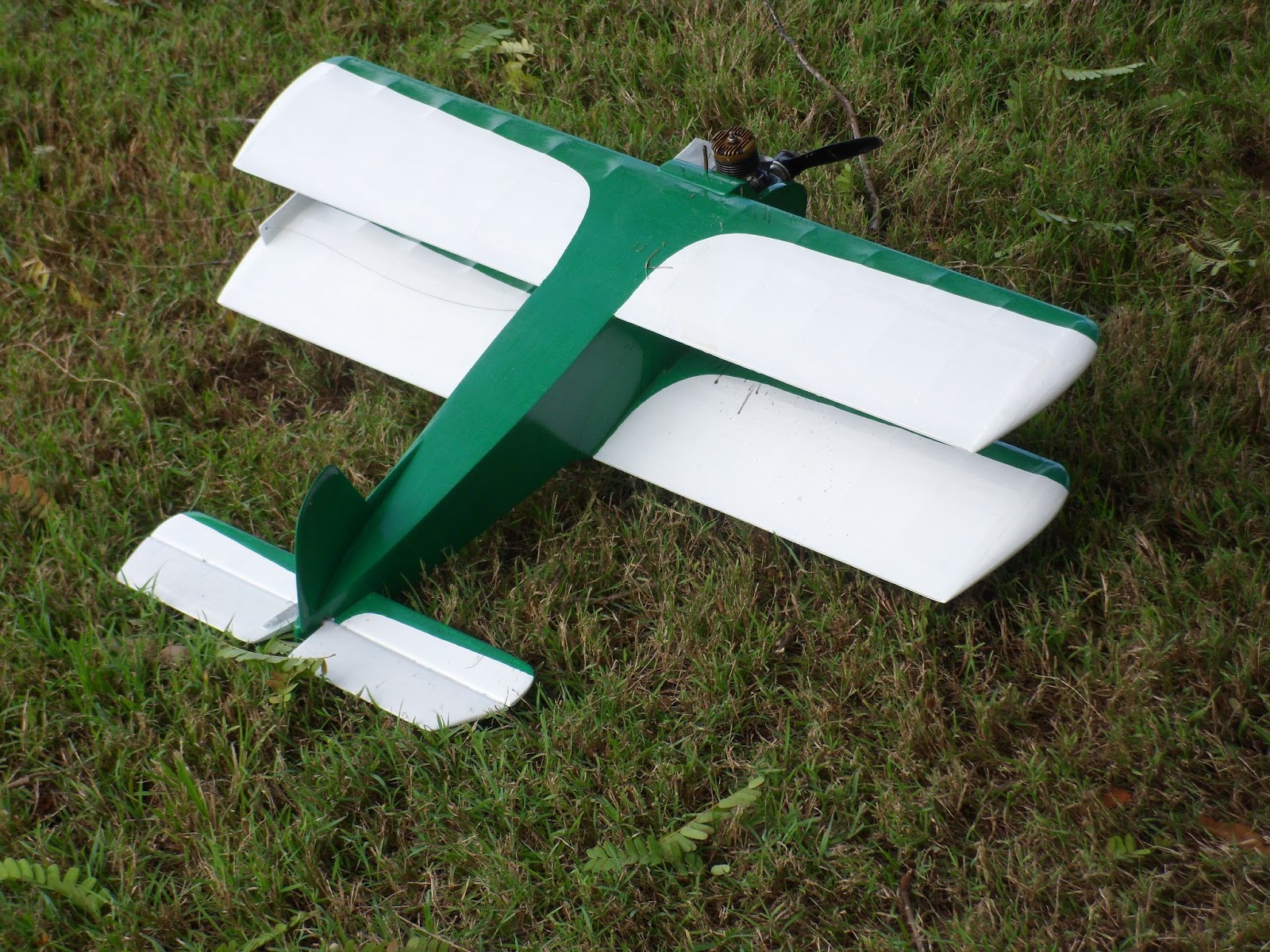
Bi-slob mania is catching on. Here is Jim Greenwood's new one. Powered by a Fox .35 with a commercial tongue muffler and three bladed prop. Weight 35 ounces all up.


Sunday, 12 May 2013

Alan Beggs test flew his new Gordon Burford designed 1949 WOMBAT powered by a Burford .29 Glow Chief.  Alan says it is a little nose heavy but it  flew alright. Glides like a brick though! He only had one flight as the wind was getting pretty strong.


Alan's homemade lightweight tin muffler on the Glow Chief. Works great!

It is with great sadness that I must tell you Bob McKenzies Nobler is no longer with us.

The wreckage was exactly as you see it. 


The Nobler Body Bag.
On a brighter note, I hear Nobler #2 is well on the way. It shouldn't be too long.

Wednesday, 8 May 2013


Well, this is my attempt for Indoor Control Line Flying. I downloaded Tania Uzunova's plans from Stunthangar.com. 
I bought the depron foam from Trade Warehouse Direct in WA. (good, fast service). I got 4 sheets of 3mm and 3 sheets of 6mm. The Gee Bee took a little over one and a half sheets of 6mm and close to a full sheet of 3mm.

The rest I got from Hobby King in Sydney.......
1 Turnigy MAX80W 7A LiPo charger with balancer
1 AM1002A/17459 2mm gold connectors (20 pcs)
1 Tz12A/25867 Hobbyking 12A ESC
1 pack 9329000028/30299 Slow Fly props 1045 (4 pcs)
2 N850.2S/35168 Turnigy Nano Tech 850mA/Hr 2S (2 cell) ~40C LiPos
2 2205C-1400/20627 2205C 1400KV outrunner motors  Edit: 20/08/13.  These motors are listed as 1400KV, which means they will do 1400 revs per volt. I am using 2S Lipos (7.4volts) and I cannot get more than 4700 rpm out of either motor. They should do 10000rpm. I do not recommend buying them.

1 ZTRON Timer, Model CLT3 (contact Sergio at: zigras_sergio@yahoo.com )

The timer is used for the following functions:
When the system is turned on the timer provides an adjustable delay before the motor starts to give you time to get out to the control handle. The motor then starts and runs for a pre-programmed time up to 10.5 minutes. The motor will turn off and on 3 times to alert you that the time has almost run out. Fifteen seconds later the motor stops and the plane can be landed. There's a bit more to it than that but it gives you the basic idea. There are other timers available also.

Dubro wheels and 2mm carbon pushrod from Tiger Hobbies, Launceston

Bellcrank , control horn and engine mount made from PCB (Printed Circuit Board).
Some guys are using old Compact Discs for the bellcrank & control horn. (Light and strong)

Braided fishing line - local tackle shop. Minimum 14lb (6.3kg) breaking strain.

Paint is acrylic poster paints from the local newsagency. $12.00 for a pack of 12 colours.

The Depron must be cut with a very sharp knife. Replace the blade often to avoid tearing the depron.
I did not have a great deal of luck using foam safe super glue as recommended and had to use kicker to get it to go off. If too much kicker was used, it melted the foam. In the end I reverted to Titebond wood glue (which sticks like poop to a blanket!) and 5 minute epoxy for the engine mount, bellcrank and control horn.

I hinged the elevator by using 50mm wide, clear post office sticky tape the full length of the hinge line.
I am not sure where the C of G is supposed to be but I will start at 25% chord. [EDIT]: Peter Allen advised that CG & LO positions are listed half way down this page:-  http://stunthanger.com/smf/index.php?topic=19265.0  (CG 2" back from LE, Lead out 6" back from LE.)
The weight has ended up at 250 grams (approximately). I probably should not have painted it. Paint is heavy.
Anyway, this will do me for my first attempt. Now I just need a place to fly it. I am hoping the local council will let me use the indoor basketball courts. Hopefully I will post a video of the first flights in the coming weeks.

Here are the electrics from Hobby King.
The rectangle at the lower right is the ZTRON timer.
I even put the depron offcuts to good use
with this foam version of a Hangar Rat.

Putting the airfoil into the foam for the hangar rat was interesting. I rolled the depron with a dowel about the diameter of a broom stick, (actually, it was a broom stick), while exerting a lot of downward force. The foam would not deform sufficiently to give a decent airfoil and I found that the depron seems to have a "skin" on one side and a "grain" running in one direction.  I ended up using a piece of scrap depron and tried rolling it each of four different ways. Only one of those ways was satisfactory. I can't tell you which was the right way because you can't see the "grain" or the "skin".
So if you are going to try deforming depron, use a piece of scrap to find the correct orientation to roll.

If anyone wants any further info, contact me at johnmoody@westnet.com.au 

Sunday, 5 May 2013


Owen Cameron's old Tazy Rat rat racer has been resurrected after a prang many months ago. Same wing and tail with a new fuselage, revamped fuel shut-off and a lot less sensitive control setup.
Note the internal bellcrank and lead-outs.


Thursday, 18 April 2013

Alan Beggs hovers his Bislob for the first time....


Sorry about the resolution. The original video was HD but Blogspot would not let me post it. I had to keep reducing the resolution until it did. It's best viewed in the size above.

Sunday, 24 March 2013


MULTIPLE WING RIBS WITHOUT USING PINS.
by Bob McKenzie.

How many times have you made wing ribs by stacking and pinning and have the stack flex or the pins dig into the bandsaw plate and going off line?

Try this for a tapered wing. For this example, a Top Flite Nobler.....

As another member of our little group was also constructing the Top Flite Nobler, I offered to make a rib set for him, as all it would need would be to laminate some extra sheets and still only make use of the bandsaw once.

I cut and pasted paper templates of each rib size onto a suitable size sheet of balsa to maximise the number of ribs then cut 3 more blanks of each size.

Problem! As each rib stack consisted of only 4 pieces of 1/16” balsa, pinning was out of the question as small stacks of 1/16” pinned together do not remain firm and you have to cut the pins flush with the balsa to stop them snagging on things (which doesn't work – they still snag!).
How could I hold them firm enough to cut to the templates and accurately cut L.E. and spars?

First, I aligned each set of 4 sheets and applied super glue at each corner. Next I drilled a 1/4” hole in the centre of the lead out cutouts on each rib stack. A drop of super glue was placed in each hole on each stack. After the super glue had set, each stack was trimmed to its template, a final sand to shape and the L.E. notch and main spar slot were cut using a bandsaw.

If you have a small bandsaw like me, (a GMC 150), it would be best to make mirror images of the paper templates to allow the ribs T.E. to face the right hand side of the bandsaw so they don't foul on the relatively narrow throat of the bandsaw. I had to cut the spar slots on these ribs using an Exacto mini saw. If you have a larger bandsaw, no problem.

To separate the stacks of ribs when you are finished, cut out the leadout slots. I used an endmill to drill neat holes at each end of the slots then cut the remainder with a knife. See illustration 4.

This method could be used also on parallel chord wings.


Wednesday, 20 March 2013


Owen's 38 Special all painted up and ready for a test flight. Powered by a Super Tigre .34.


Thursday, 14 March 2013

Lyal Cameron has modified one of his combat wings and turned it into a fast stunter.
 Powered by an ASP .15


Monday, 11 March 2013


It's a little late for a report on the Nats but here it is for those who are interested.......


    Report On 66th Australian Nationals Aerobatics Events by Peter White.

The Nationals were run on one of the sports ovals at the Alexandra Park Sports Complex in Albury, a regional city on the border of Victoria and New South Wales, from December 29th to January 3rd. The flying surface was well mown if a little undulating and showing the effects of the hot dry weather the area has been experiencing over the summer period.
Temperatures at the beginning of the week were in the low to mid 30s C and crept steadily up to the very high 30s as the week progressed. The wind, for a change, was not really an issue apart from an occasional rough patch that came through. It tended to drift around in the mornings catching some flyers unawares and requiring constant repositioning of the judges but in general, as each day wore on it became more insistent but quite manageable.
F2B was flown over four rounds with the best three scores being counted. Advanced and Expert were run separately and alternated on each of the four days giving both classes equal exposure to morning and afternoon conditions.
All of the events, F2B, Classic and Vintage, were ably CD’d by Frank Battam while Alan Matthieson-Harrison carried out all line pull duties for the week. Score tabulation was very efficiently handled by Susan Hegarty and Steve Vallve did the bulk of the score sheet running and posting of scores .... our thanks goes to these hard-working people and all others who chipped in at various times.

ADVANCED.
A field of seven flew in this event with Robert Graham taking out first place running an electric powered SV 11 fitted with an Arrow Wind 2832 with a Phoenix speed controller and a Hubin timer. Robert put in some good flights enabling him to win by a comfortable margin. Second spot went to Steve Bakac flying a Turnigy 4S 2650 powered Europa with ZTW controller and KR timer. He flew some neat manouvres but didn’t seem to be up to his usual standard. Peter Koch guided his ex-Doug Grinham Jazzmate/Stalker 61LT combination into third place with some well flown shapes along with his share of missed bottoms and intersections.
Newcomer to Nats competition, Adam Pogue, flew a Saito 56 powered ex-Reg Towell Seafire. Adam had his four stroke starting technique sorted out and the motor well tuned. He tended to fly quite high, not being totally familiar with the model.
South Australian “retread” from the 60s, Jeff Prosser, put up some well shaped manouvres with his electric powered modified Legacy running an EMAX motor, ICE LITE 50 speed controller and Hubin FM 9 timer. Bottom heights and 45s were generally good and flown confidently. Jeff is one of a group of SA fliers who have enthusiastically taken to electric powered aerobatics.
Tony Clifford had his OS LA 46 running consistently in his neatly built scaled down KA-10. Heights were varied but with increasing confidence, Tony’s flying is improving.
Nats regular Don Keyssecker, flying his OS LA 46 powered Vector 40 put in some reasonably good patterns, missing some intersections and bottoms along the way.
Judges for the event were Joan McIntyre, Russell Bond and Peter White.
EXPERT.
A total of seventeen in Expert class flew in front of judges Joan McIntyre, Don Keyssecker and Dave Simons. Of these, Russell Bond and Bruce Hoffman ran electric power – Russell with a Plettenberg 25-10, ICE LITE 50 speed controller, Hubin FM 9 timer and Bruce with an Arrow Wind 2832, JETI 66 speed controller and Igor Berger timer. Both set-ups ran flawlessly, producing an abundance of power and were totally consistent.
Almost one third of the field was made up of Jatsenko models. Frank Battam ran a Yak 55/Retro 76 combination while Peter Anglberger and Mark Ellins each flew a Retro 76 powered Classic 111. Eventual winner, Mark Batty, put his Shark through four precisely flown patterns to top second spot by a mere four points and show us how it’s done. Most of the Retros had what appears to be a characteristic rattle in parts of some manouvres although this didn’t seem interfere with their performance in any way.
Fitted with a side mounted Stalker 66, Barry Frederickson’s Classic 1 appeared to be handling well. Barry is capable of flying precise square turns with generally good heights.
Doug Grinham ran a Stalker 66 in his O/D Starcraft. In its original form this motor, similar to many other Stalker 66s, would not run symmetrically unless it was side mounted. Doug has had some mods done to the crankshaft timing resulting in a powerful, consistent running motor that is now quite happy to run in an inverted mounting situation.
The lone four stroke in Expert was Reg Towell’s Saito 56 fitted to his Miss America. Reg, as usual, put in good flights consisting of neat manouvres with many accurate heights and intersections.
Paul Turner’s Wind Wonder/Stalker 61LT suffered a prop strike on the first round takeoff and for various reasons Paul elected to not fly the remaining rounds.
Flying a Muggleton 40 powered Sukhoi, James Batty claimed third place with the same model that his father, Mark, had used to win the 2001 and 2002 Nationals. The Sukhoi, in James’ capable hands, flew as though on rails, having been finely trimmed over many years of competition flying.
Tony Bonello’s Firecracker featured a standout finish and a superbly running Super Tigre 60 which, with its deep exhaust note, gave an impression of power and smoothness as it four cycled through the pattern while Brian Eather’s O/D Firecracker performed very well, its Stalker Pro Series 61 putting out a great deal of power to haul the large model around with little effort.
Steve Masterton’s ST 60 powered Firecracker flew well, appearing to be stable and well trimmed but despite flying some good shapes he lost valuable points on wandering intersections and heights.
Joe Parisi took out second place flying his PA 75 equipped Hot Pursuit. Joe was running the PA on a long Eather pipe giving a similar run to that of a muffled motor with lower revs and a lower pitched exhaust note .... with the power that is available, the model is very positive in all parts of the pattern.
Sporting yet another eye catching paint scheme was PJ Rowland’s piped PA 75 powered modified Thunder Gazer that was flying well and scoring accordingly until landing gear failure caused damage to the underside of the fuselage and wing. In the two flights he made, PJ had scored third highest for both rounds, which must have made his exit from the competition all the more disappointing for him.
A lack of preparation on my part along with broken starting leads, lost wingtip weight and a lazy Stalker 61 all contributed to a lack-lustre performance from my GEO-XL and its pilot. A small number of flyers, self included, were caught out by the heat and humidity with missed needle settings, unsuitable props, etc.
When the dust finally settled, it was decided that father and son Mark and James Batty, had taken out first and third places, surely a first for our Nats, separated by Joe Parisi in second spot while Brian Eather sat in fourth place by two points and Russell Bond a further six points down. 

Peter White.

Tuesday, 26 February 2013

Here is Arthur Hume's rebuilt Thunderstreak, aptly named Skinnystreak as it is now a profile fuselage.
Original wings, tailplane, fin and tank. Powered by a K&B .35 Stallion.
Notice how Arthur has extended the ply doublers to behind the wing for a bit of added strength. 


Sunday, 24 February 2013

Owen tells me this is the result of a rainy day spent in the shed. It's a Brodak 38 Special built from plans.
(Real men don't need kits!)
More photos as they become available.


Saturday, 23 February 2013


Borrowed from Tulsa Gluedobbers C/L Club

http://www.tulsacl.com

Helpful Hints
by Jim Carpenter 
http://www.tulsacl.com/tp.gifAlong the road of model building and flying I've picked up a few tricks. I hope the following will help beginners and experts alike.
1. Use a wheel collar on your drill bit and you have a depth gauge or drill stop.
2. When mixing epoxy a 50/50 mix is critical in order to gain maximum strength. Use a coin or bottle cap to trace two circles to place epoxy in equal amounts.
3. For epoxy mixing pads use flexible plastic, like butter container tops. After epoxy cures simply flex the plastic top and epoxy can be cleanly removed.
4. Craft sticks (popsicle sticks) at Hobby Lobby make great inexpensive epoxy mixing sticks. They make great shims for lining up wings and fuselages etc.; they are also good for repairs such as spar splices.
5.Use craft sticks on the top and bottom of the elevator along with clothes pins or rubber bands to hold elevator in neutral while setting up controls.
6. To cut brass, copper, or aluminum tubing; roll on flat hard surface with a sharp knife.
7. To clean planes use rubbing alcohol then shine covering with Armourall or Son of a Gun.
8. Use fuel line tubing on needle valves to seal from leaks.
9. To separate backing on film covering put small pieces of tape on each side and then pull tape.
10. Baking soda and CA glue make great fillets for repairs.
11. Cut off the top of the fox needle valve leaving enough to solder a wheel collar on. This keeps the needle valve from being damaged on inverted landings.

Friday, 22 February 2013

Jim Greenwood's Beemin Stunter all finished.


Thursday, 21 February 2013

I couldn't resist. I had to post this video. Turn your sound up.

Well done, Bob & Arthur.

BUGGER!!


Monday, 18 February 2013


Bob McKenzie's Nobler Lives Again..

(Refer to last month's post for the crash details).


In the following video, Bob describes how many operations and transplants the Nobler has had.
God, Bob. If it was a horse I would have shot it!!